Skip to content

Industrial IoT & Digital Twins

The Digital Twin Facility.

We build physics-informed live twins of the plant that runs your building, your factory or your AI data centre — connected to the equipment you already have, judged against healthy physics, and readable by the people who operate it.

Twins in production
9
Live demos below
3
Largest facility modelled
50 MW
Pilot from
$40k

Live demos

Inject a fault. Watch the twin find it.

Three twins on simulated, generic plant data, each a single page that runs in your browser. Pick one, press Launch and break something.

Open full screen

Live digital twin

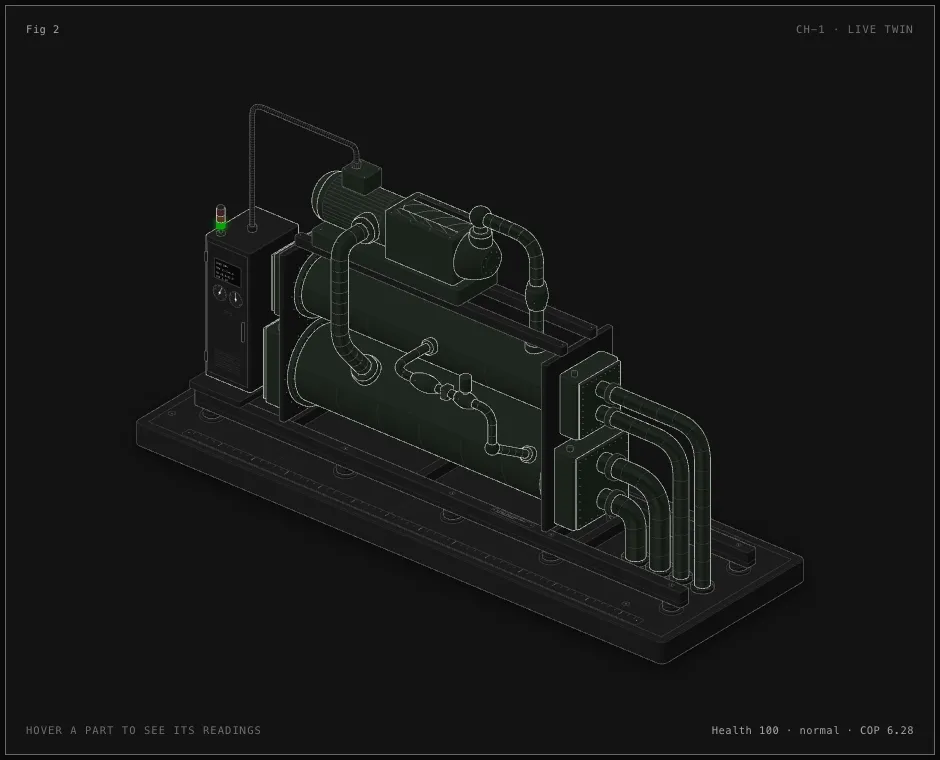
500 kW water-cooled screw chiller

Runs entirely in your browser · about 1–2 MB

A full refrigeration cycle drawn as a precise model. A simulator plays the chiller and its sensors; the health engine sees only the readings and blames each fault on its own component.

  • Condenser fouling
  • Refrigerant leak
  • Low chilled-water flow
  • Cooling-tower fan failure
  • Compressor bearing wear

Try this

  1. Press “Condenser fouling” under Inject a fault
  2. See the condenser turn amber, then red, in seconds
  3. Check Energy now for the kW lost against a healthy chiller
Get a twin of your plant

Built by Ideaxa Solutions with simulated, generic plant data. Isometric drawing kit by Ryan, used under the MIT licence.

Short on time? Watch the 15-second cut.

A GPU rack’s cold plate blocking, a hospital twin’s day and a chiller’s condenser fouling, recorded from these same twins.

Teaser · 15 sSimulated, generic data · captions on screen

The video opens on the Ideaxa live campus, a simulated model of a hospital, an AI data centre, a VRF office tower and a chiller plant linked to one twin core, then shows the sensor-to-decision loop every engagement follows. It runs the twin platform's AI data centre through a simulated day, injects a cold-plate blockage into a liquid-cooled GPU rack, which turns amber and then red as the energy lost is booked, tours a hospital twin's operating-theatre air handlers, ICU and isolation rooms, fouls a chiller's condenser, and reads a VRF floor through its gateway. It closes on results from delivered engagements (85% lower infrastructure spend, 99.999% telemetry reliability, 62% of support tickets auto-resolved, nine digital twins in production), the rule that Ideaxa is a consultancy and never a competitor to a client's product, and an invitation to talk to the founder. All twins run on simulated, generic data.

How the facility works

Connect, model, visualise, detect, act.

The same five stages for a single chiller or a 50 MW campus. The last one always ends at a person.

Twin pipeline
held for approvalPLANT · BMSbacnet · modbus · mqttGATEWAYedge bufferTIME-SERIESclickhousePHYSICS + MLhealthy baselineLIVE TWINisometric · healthAI AGENTdiagnose · recommendHUMAN APPROVALoperator signs offACTIONsetpoint · work order
  1. 01

    Connect

    Point mapping from your BMS, chiller and VRF gateways or meters over BACnet, Modbus and MQTT, with edge buffering so a dropped link loses nothing.

  2. 02

    Model

    A physics model of each asset, calibrated on your data, that rebuilds the healthy plant at the measured load and weather.

  3. 03

    Visualise

    An isometric live model your operators can read at a glance: every part coloured by health, with comfort, system and energy views.

  4. 04

    Detect

    Each reading graded against healthy physics, so a fouled condenser or a blocked cold plate is named and located, not just alarmed.

  5. 05

    Act

    An AI agent explains the fault and recommends the fix; a person approves it before anything changes in the plant.

Reference architectures

Three classes of plant, drawn generically.

Each twin follows the same pattern: subsystems report through a gateway, a model rebuilds the healthy plant, and the difference becomes health and energy.

Digital twin
foulingCHILLERS3 × 800 trCOOLING TOWERSapproach · fansPUMP LOOPSprimary · secondaryGATEWAYbacnet · modbusPHYSICS MODELhealthy plant at loadLIVE TWINhealth per partENERGYkw/tr · kw lost
Digital twin
gateway codeINDOOR UNITSfan coils per roomOUTDOOR UNITSinverter condensersVRF GATEWAYbacnet · modbusZONE MODELfloor · room · setpointCOMFORTdrift per roomEFFICIENCYcop · energy index
Digital twin
blockageGPU RACKSdirect-to-chipCDUpumps · plate hxDRY COOLERec fansHEALTH ENGINEflow · rise · approachLIVE TWINper-part statusENERGYppue · kw lost

In production

Nine twins, five domains.

Production twins run on client platforms under NDA, so they are listed by class and scale only.

TwinDomainScaleTracks
AI factory data centreData centre50 MW, 360 racks at 40–100 kWPUE · Loop ΔT · Thermal rejection
Central chiller plantHVAC3 × 800 TR centrifugal, primary-secondary pumpingkW/TR · COP · Tower approach
Office tower VRFHVAC10 floors, 359 indoor and 20 outdoor unitsEnergy index · COP · Inverter Hz
Floor-zone VRFHVACRoom-level thermal zones on a CAD layoutZone airflow · EEV opening · Setpoint drift
Industrial cold storeRefrigeration4,940 MT multi-chamber ammonia plantkW/TR · Holding temp · Pull-down rate
33/11 kV substationPower2 × 10 MVA, dual busbar, OLTCBusbar kV · MVA loading · Tap position
Urban distribution microgridPower300 homes, 11 kV, 10 transformersSAIFI / SAIDI · Voltage in band · Net load
Village feeder microgridPower120 metered nodes over LoRaWANPhase imbalance · Line losses · Transformer temp
Islanded campus microgridPower1.2 MW solar, 2.5 MWh battery, 1.5 MVA dieselState of charge · Frequency · Fuel flow

Case studies

Twins and plant work under NDA.

All case studies →
Industrial IoT & Digital TwinsNDA · Commercial buildings

A live digital twin of a 2,400 TR central chiller plant

Production twin on a private client platform

Three 800 TR water-cooled centrifugal chillers on primary-secondary pumping, modelled from first principles and bound to live plant telemetry so faults show up as physics, not as alarms after the fact.

kW/TR plant efficiency tracked live
0.58kW/TR plant efficiency tracked live
Chiller COP on the dashboard
6.06Chiller COP on the dashboard
Cooling-tower approach watched per cell
2.8 °CCooling-tower approach watched per cell
Industrial IoT & Digital TwinsNDA · Commercial real estate

Every VRF unit in a 10-floor office tower on one live model

Production twin on a private client platform

359 indoor fan-coil units and 20 rooftop outdoor units, read through their gateways and drawn floor by floor so facilities staff can see comfort, faults and efficiency at once.

Indoor units on one live view
359Indoor units on one live view
Outdoor condensing units modelled
20Outdoor condensing units modelled
Floors zoned independently
10Floors zoned independently
Industrial IoT & Digital TwinsNDA · Data centres

Thermal twin of a 50 MW AI factory and its liquid-cooled GPU racks

Production twin on a private client platform

360 racks at 40–100 kW each on direct-to-chip cooling, perimeter air and dry coolers. The twin tracks every loop against healthy physics and prices the energy a fault is costing.

Facility modelled end to end
50 MWFacility modelled end to end
Racks at 40–100 kW each
360Racks at 40–100 kW each
Simulated PUE against a 1.12–1.25 target
1.18Simulated PUE against a 1.12–1.25 target

Engagement

Start with one system, on a fixed fee.

A pilot covers one plant system end to end — usually the chiller plant, a VRF floor or a GPU pod — and ends with a running twin and an energy report you can take to the board.

Point schedule
Every BMS and gateway point mapped, named and documented.
Calibrated physics model
Healthy-plant baseline per asset, versioned with its test suite.
Live twin
Dark and light, runs in any browser, hosted in your estate or ours.
Fault library
The failure modes we inject and detect, with measured time to first colour.
Energy report
kW and kWh lost against healthy, per fault and per part.
Handover
Runbooks, recorded walkthrough and the option to keep us on for operations.

Fixed fee · 4–8 weeks

Digital Twin Pilot

From

$40,000

fixed fee

A physics-informed live twin of one plant system, connected to your BMS or gateway data, with fault detection and energy accounting.

  • Data audit and point mapping (BACnet, Modbus, MQTT)
  • Physics model of the asset, calibrated on your data
  • Live isometric twin with health and fault views
  • Energy-loss report against a healthy baseline
Ask about this engagement

FAQ

Questions facilities and data-centre teams ask.

What does the twin need from our site?

Read access to the BMS or the equipment gateways over BACnet, Modbus or MQTT, plus nameplate data and drawings. We bring the edge gateway if you do not have one. Nothing writes to your plant without a human approving it.

Is the data in the live demos real?

No. The demos run on simulated, generic plant data so they can be shared publicly. Client twins run on the client's own telemetry, in their estate, under NDA.

How is this different from BMS alarms?

A BMS alarm fires when a point crosses a fixed limit. The twin rebuilds what a healthy plant would read at the same load and weather, so it catches drift long before a limit is crossed, names the component responsible and prices the energy it is costing.

Which equipment do you cover?

Chiller plants with their cooling towers and pump loops, VRF systems, liquid-cooled GPU racks and CDUs, ammonia cold stores, substations and microgrids. Nine twins across those classes run in production today, and the same method extends to AHUs and other plant.

Where does the twin run?

Wherever your security team prefers: in your cloud account, on a server in your plant room, or hosted by us. Each twin is a self-contained web app, so it also works offline for site walk-throughs.

Bring us one plant system.

Send the drawings, a BMS export or a nameplate photo. We will tell you what a twin would see in it, and what a pilot would cost, before you sign anything.

Mutual NDA before any detail is shared. First response within 24 hours.